
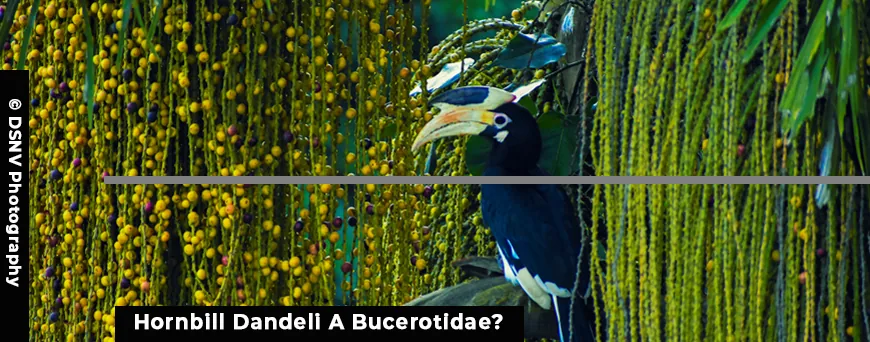
Welcome again — we are happy to announce a collaboration with the DSNV group, bringing more ways to explore Dandeli. In this post you will learn some essentials about hornbills in Dandeli.
What is Bucerotidae?
Bucerotidae is the scientific name of the hornbill family. It includes some 55 living species. Their distribution ranges from Africa (south of the Sahara) and the Indian subcontinent to the Philippines and Solomon Islands — but no genus is found in both Africa and Asia. Most are arboreal birds. The Indian subcontinent has 10 species of hornbills, of which 9 are found in India.
Author: Kiran Bhagannavar · Image credit: DSNV_PHOTOGRAPHY
Giants among forest birds
Hornbills in Dandeli are giants among the forest birds. They are bizarre, awe-inspiring and spectacular. They also play essential roles as seed dispersers of plants in the forest. They are named for the shape of the bill; they feed on fruits and small animals. Males are bigger than females, with variation by species.
Yet many hornbills are today threatened by habitat loss, hunting, and loss of large trees that they need for nesting. They are monogamous breeders nesting in natural cavities in trees and sometimes cliffs. Nesting sites may be used in consecutive breeding seasons by the same pair.
When the female is ready to lay her eggs, she incarcerates herself in the tree hollow for three to four months and seals the entrance — often with droppings — leaving only a slit through which the male delivers food. At nesting time this is an amazing culture they follow.
Image credit: Naren Patil

Four species you may meet in Dandeli
If you are visiting the Western Ghats of Karnataka for the first time, you may encounter a large bird with an inordinately large beak. Around Dandeli you can find four species:
- Great Hornbill (Buceros bicornis) — also across parts of India and Southeast Asia in dense forest
- Malabar Pied Hornbill (Anthracoceros coronatus)
- Malabar Grey Hornbill (Ocyceros griseus)
- Indian Grey Hornbill (Ocyceros birostris)
One distinctive feature of hornbills is the projecting casque mounted on the large curved beak. Shapes and colours of the casque give some species their names elsewhere in the family — Red-Knobbed Hornbill, Helmeted Hornbill, Rhinoceros Hornbill.
Keep quiet near nests
Hornbills are very shy and wary. Constant, close human presence can make them abandon the nest. The picture above was taken from a distance — it takes hard work to capture a good frame without disturbing the birds.
Fascinated by Western Ghats birdlife? Follow DSNV_PHOTOGRAPHY on Instagram and Facebook — or ask us on WhatsApp for a forest stay and safari cab. Kiran Bhagannavar · DSNV
Quiet canopy time
- Dawn and dusk for movement
- Binoculars help more than phones
- Stay on trails — don’t crowd nests
Forest Department jeep
- Kulgi / Phansoli on-the-spot tickets
- Good for canopy bird silhouettes
- See our jungle safari notes
Cooler months preferred
- Oct–Feb for comfort and visibility
- Respect nesting season distance
- Confirm activities before you travel
Stays that fit a birding trip
Quiet forest-edge bases. Safari tickets are Forest Department extras.



About the author
Frequently asked questions
Which hornbill species can be found in Dandeli?
Four species are noted around Dandeli: Great Hornbill (Buceros bicornis), Malabar Pied Hornbill (Anthracoceros coronatus), Malabar Grey Hornbill (Ocyceros griseus), and Indian Grey Hornbill (Ocyceros birostris).
What does Bucerotidae mean?
Bucerotidae is the scientific family name for hornbills. The family includes about 55 living species across Africa (south of the Sahara) and from the Indian subcontinent to the Philippines and Solomon Islands.
Why are hornbills important to the forest?
They are essential seed dispersers. Their large bills and fruit diet move seeds through the canopy, helping forest plants regenerate.
How should visitors behave near nesting hornbills?
Hornbills are shy. Constant close human presence can make them abandon a nest. Keep distance, stay quiet, and photograph from far away.
Who wrote this article?
Guest author Kiran Bhagannavar for DSNV — Dandeli’s New Vision photography. Images and text are copyright DSNV and Dandeli.org; reuse needs written permission or a credit link back to this article.